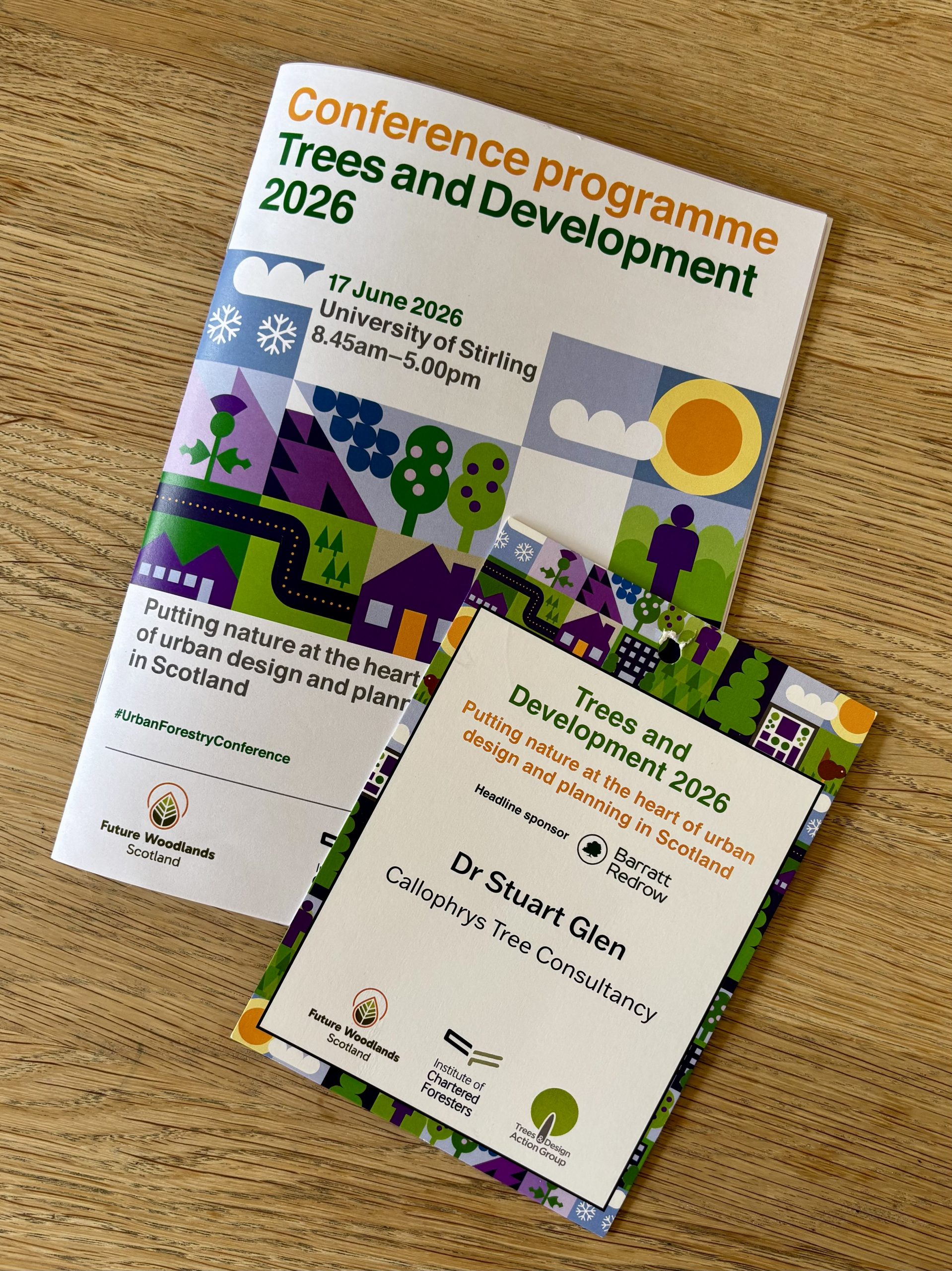
Yesterday, I joined more than 100 other delegates at the second-ever Trees and Development conference at the University of Stirling. The conference, curated by The Trees and Design Action Group, Future Woodlands Scotland and The Institute of Chartered Foresters, set out to tackle the issue of how we create places that work for people, work for nature, and work for the planet. It did so, however, in the most ingenious, innovative and engaging way.
The programme opened with a client outlining ambitious plans for an exemplar residential development of 65 homes on a former industrial site adjacent to an ancient woodland. The conference then followed every aspect of the different phases of development from the perspectives of a multidisciplinary team of professionals. The sessions were as follows,
- Starting right – the brief, the site, the design team
- Concept design – making the building, landscape and trees work together in harmony
- Planning-ready design without dilution
- From design to reality – delivering the design intent on site
Yes, root protection incursions are possible with sensitive and/or creative design, but the indefatigable Peter Wharton of Wharton Natural Infrastructure Consultants [Peter presented in all four sessions] reminded the audience that paramount should be the consideration of the mitigation hierarchy – Avoid > Minimise > Mitigate > Compensate – where there is a shared commitment to retain as many trees as is practicably possible.
Ultimately, achieving success depends on close collaboration between clients, design professionals, specialist consultants, and local planning authorities, working together from the earliest stages through to delivery, and beyond (e.g. ongoing maintenance). Assembling the appropriate multidisciplinary team of professionals from the outset will ensure trees are no longer regarded as a constraint; instead, trees become the asset that defines the project. Only then will we truly succeed at putting nature at the heart of urban design.
Leave a Reply