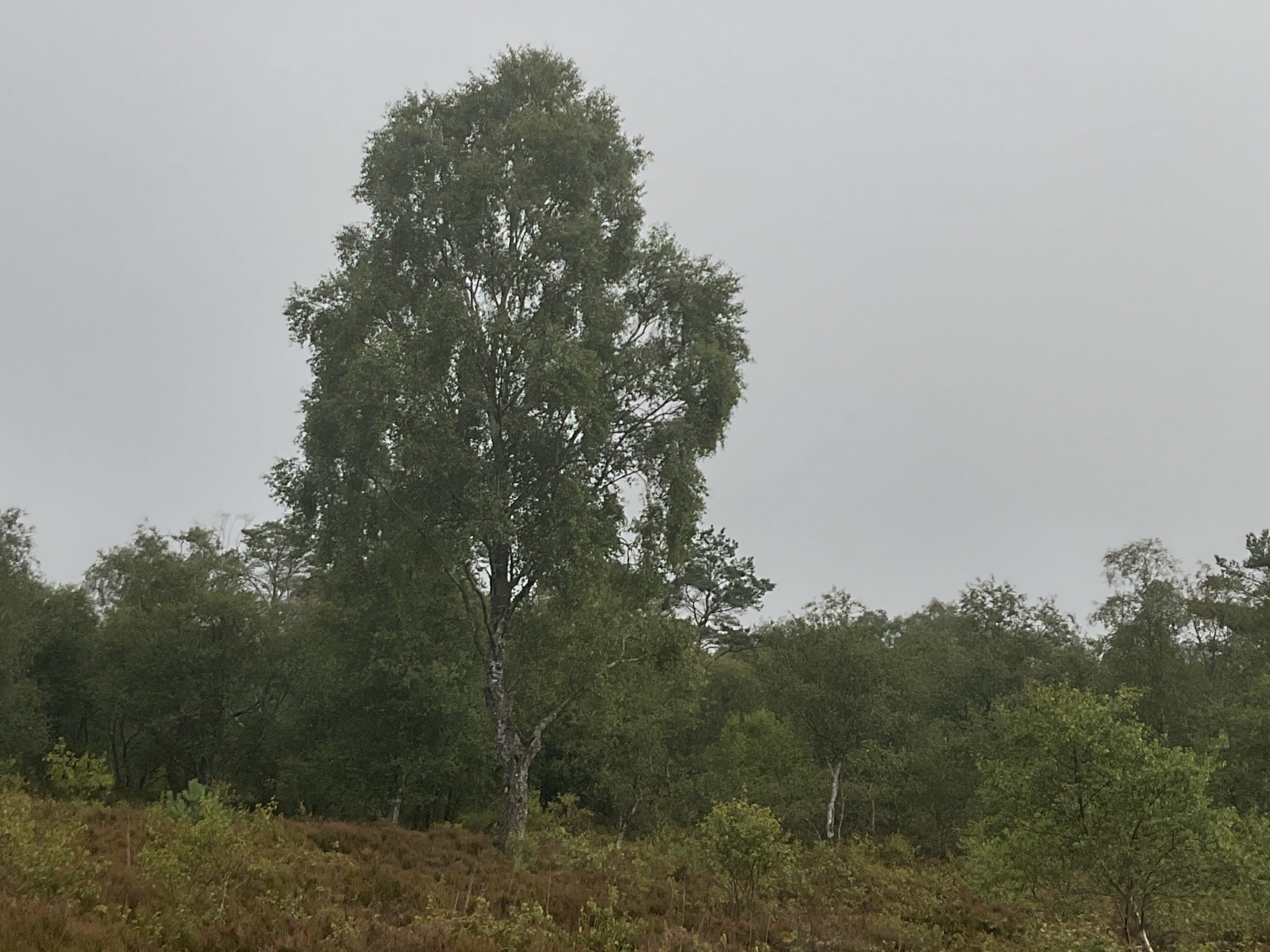
Immortalised by our nation’s bard, the birch trees that cloak the steep glen on either side of the Moness Burn, to the south of Aberfeldy, were the source of inspiration for one of Robert Burns’ most well-known compositions, The Birks o’ Aberfeldie.
‘Now simmer blinks on flow’ry braes,
And o’er the crystal streamlets plays,
Come let us spend the lightsome days
In the birks of Aberfeldie!’
As a result, the glen has been maintained as a scenic walk for more than 200 years, and the birch trees of Aberfeldy have become famous around the globe.
Spiritually connected with rebirth and new beginnings, birch is one of the first trees to recolonise an area after a mature forest is felled.
There are three main species of birch native to the UK: silver birch (Betula pendula), downy birch (Betula pubescens) and dwarf birch (Betula nana). Additionally, several non-native species are routinely planted in parks and gardens, including Himalayan birch (Betula utilis), paper bark birch (Betula papyrifera) and Erman’s birch (Betula ermanii).
Downy birch is frequently cited as the most northerly growing broadleaf tree in the world, occurring well into the Arctic Circle.
But how do you distinguish the two main species of birch native to the UK? The table below details some of the key differences between silver birch (Betula pendula) and downy birch (Betula pubescens).
| Silver birch Betula pendula | Downy birch Betula pubescens | |
|---|---|---|
| Distribution | Widespread throughout the UK. | More common in the Scottish Highlands. |
| Soil preference | Light, dry soils; and shallow peat. | Damper soils; poorly drained heaths. |
| Form | Older trees slowly lose their pointed top to become high domed, with long, pendulous branches. | More erect. Irregular crown, upright and stiff; twisting branches and spreading shoots. Not pendulous. |
| Height | Regularly grows up to 30 m in height. | Short-lived tree, growing to a height of 20-25 m. |
| Bark | At first the bark is shiny red-brown (like a cherry tree), later pinkish-white and, finally white with large, black diamond-shaped lesions. On older trees, the bark is often deeply fissured at the base, forming small, black gnarled plates. | At first the bark is red-brown, becoming smooth greyish-brown, rather than white. There is an abundance of horizontal bands or scars (lenticels); but black diamond-shaped lesions are never present. |
| Leaves | Pointed oval leaves with toothed margins. 3-7 cm in length, truncate, slightly rounded triangular; six pairs of veins to protruding, tapering teeth separated by 2-3 smaller teeth; petiole slender and glabrous. | More rounded, often nearly circular, 5-6 cm in length; broadest near the middle of the leaf, not near the base, with uniform crenate teeth; glistening white hairs on veins on the underside of the leaf; petiole densely pubescent. |
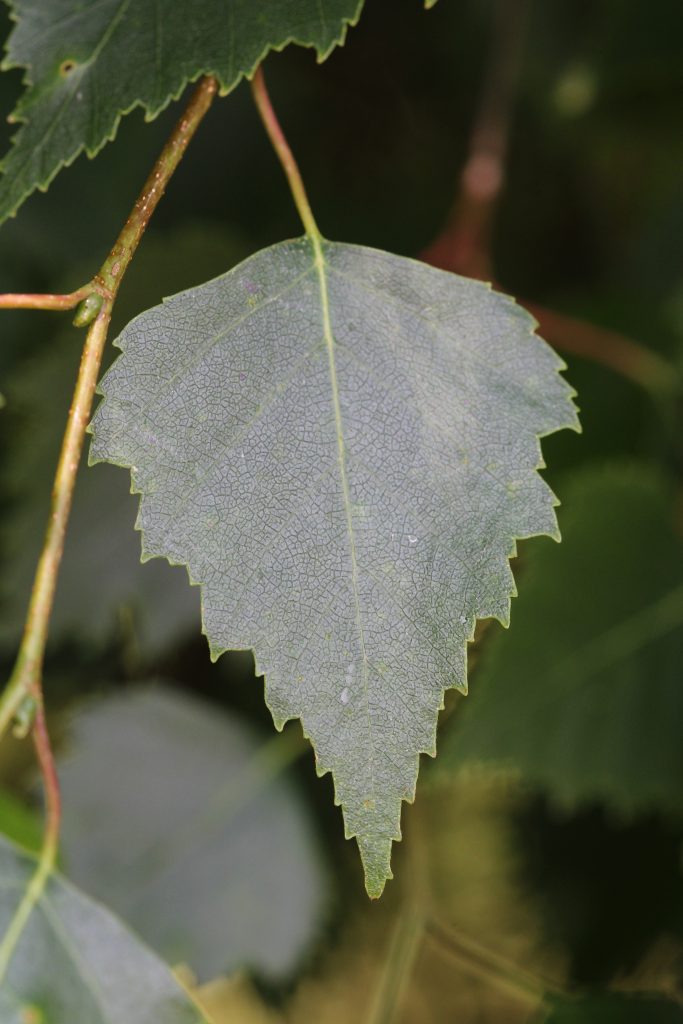
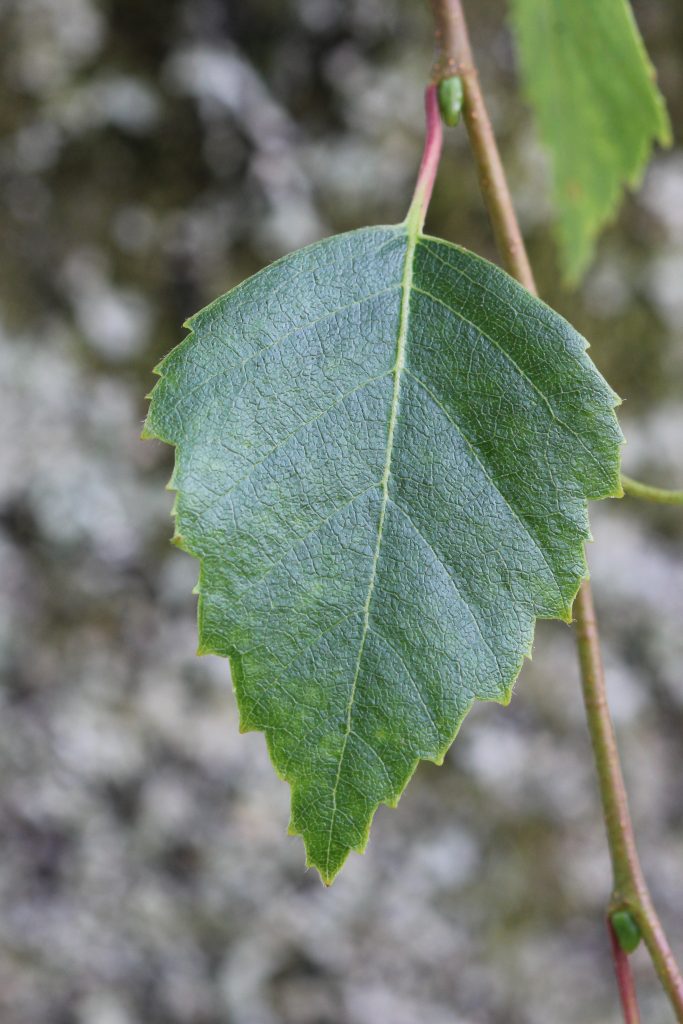
Left. Leaf of a silver birch, showing the toothed margins. Right. Leaf of downy birch, a more rounded form.
Reliable identification in the field is sometimes made more difficult by the fact that individual trees do not always comply strictly with published species descriptions, and by the ability of downy birch and silver birch to hybridise to produce Betula x aurata.
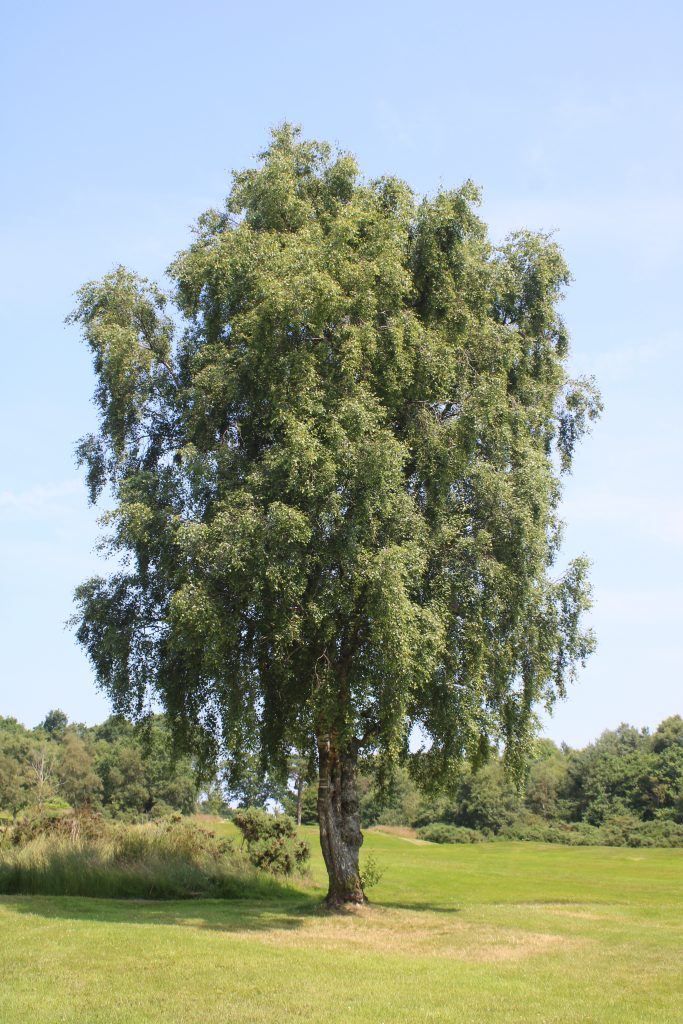
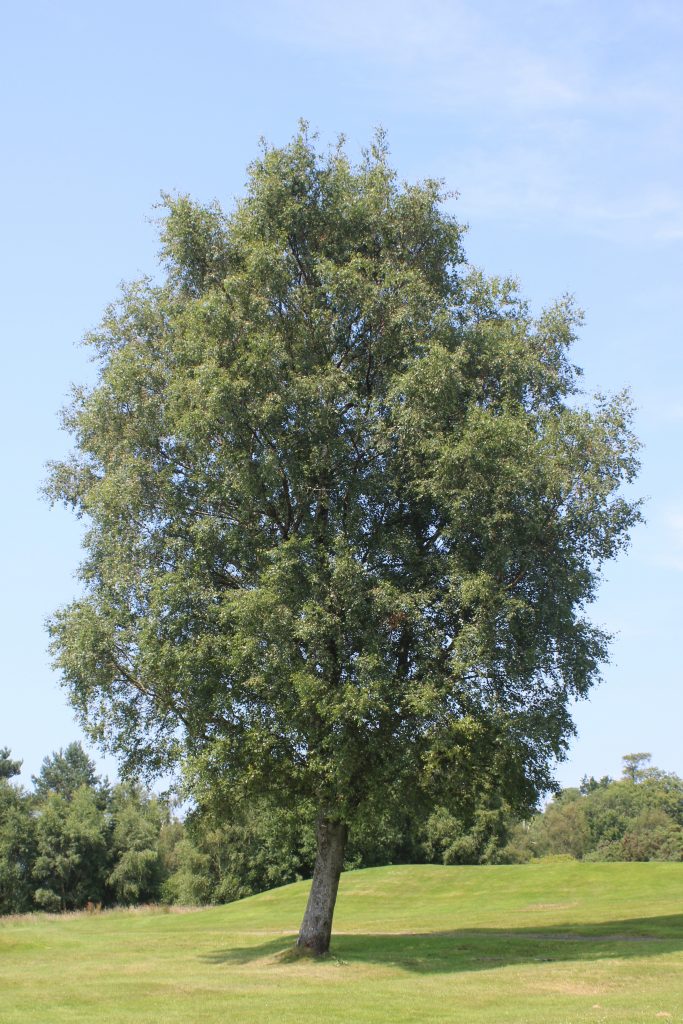
Left. Silver birch, showing the drooping, pendulous branches. Right. Downy birch, a more erect tree, devoid of pendulous branches.
Leave a Reply